
The Brazilian passport, issued by the Federal Police of Brazil (Polícia Federal) under the Ministry of Justice and Public Security, is the official travel document for citizens of the Federative Republic of Brazil. It serves as proof of Brazilian citizenship and identity, and is required for international travel outside of South America (where a national ID card often suffices under Mercosur agreements). Brazilian passports are biometric and meet ICAO international standards, with embedded chips storing the holder's photograph, fingerprints, and digital signature.
The Brazilian passport ranks as one of the strongest in Latin America, sitting comfortably in the global top 15 alongside Argentina. This top tier Latin American position reflects Brazil's economic weight as the largest economy in South America, its founding membership in Mercosur, and extensive diplomatic agreements across Europe, Asia, and Africa. Brazilian citizens enjoy a unique combination of broad global mobility plus full freedom of movement across most of South America.
Types of Brazilian Passports
Common Passport (blue cover): issued to Brazilian citizens for personal and business travel. Standard 10 year validity for adults, refreshed from the previous 5 year standard in 2015.
Diplomatic Passport: issued to members of the Brazilian government, ambassadors, and senior diplomats on official duty.
Official Passport: issued to government officials and civil servants travelling on official missions abroad.
Emergency Passport: issued by Brazilian embassies and consulates abroad to citizens who have lost their passport or need an immediate travel document, with limited validity.
Foreign Passport for Stateless Persons: issued to recognised stateless persons residing in Brazil.
Validity of a Brazilian Passport
A standard Brazilian common passport is valid for 10 years for adults. The 10 year validity was introduced in 2015, replacing the previous 5 year standard. For minors, validity is tiered by age: passports for children under 12 are valid for 5 years, and those issued to children under 1 are valid for 1 year. Brazilian passports can be renewed at any Federal Police office across Brazil or at any Brazilian embassy or consulate abroad. Most destinations require the passport to be valid for at least six months beyond the intended date of departure.
What Does It Look Like?
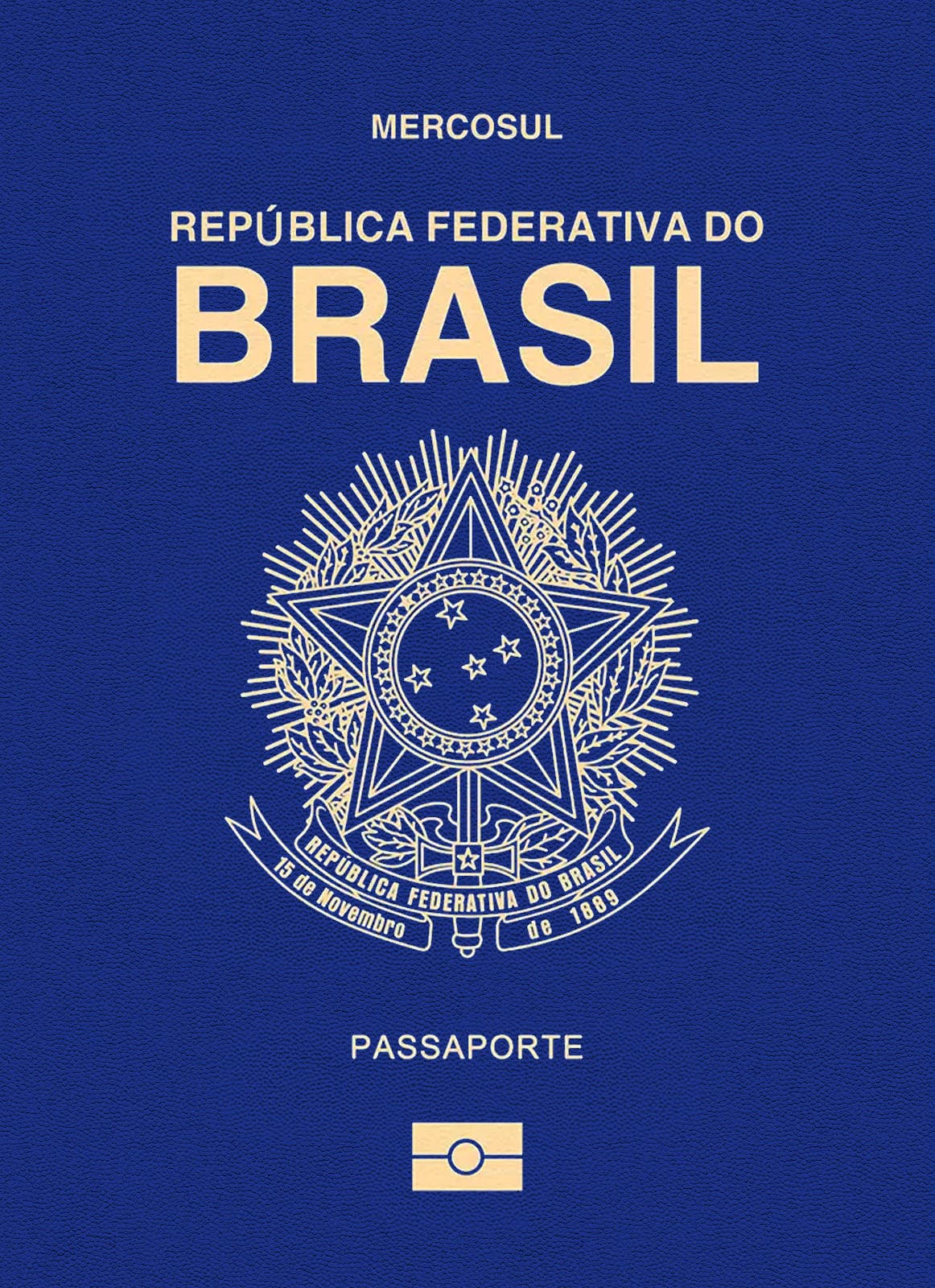
The standard Brazilian passport features a navy blue cover with the Brazilian coat of arms embossed in gold. The words "REPÚBLICA FEDERATIVA DO BRASIL" (Federative Republic of Brazil) and "MERCOSUL" (Mercosur) are printed in gold at the top, with "PASSAPORTE" (Passport) at the bottom. The cover design was updated in April 2019 with refreshed typography and enhanced security features. The biometric chip symbol is displayed near the bottom of the cover, indicating compliance with ICAO standards. Inside, Brazilian passports feature a polycarbonate data page, multiple anti tampering elements, and artistic imagery reflecting Brazilian landmarks, the Amazon rainforest, and cultural heritage from across the country's five regions.
Inside the Passport
The identity page includes the following details:
Passport holder's photograph
Full legal name (Sobrenome and Nome)
Passport number
Country Code (BRA)
Nationality (Brasileira or Brazilian)
Date and place of birth
Sex
Date of issue and expiration
Issuing authority (Departamento de Polícia Federal)
Signature of the bearer
CPF number (Brazilian tax ID, optional)
Machine Readable Zone (MRZ)
All Brazilian common passports issued since December 2010 contain an embedded biometric chip storing the holder's photograph, fingerprints, and digital signature.
Visa Free Access with a Brazilian Passport
As of 2026, Brazilian passport holders can access 163 destinations without applying for a visa in advance. This includes 119 fully visa free entries and 44 visa on arrival destinations. Brazilians enjoy visa free access to all Schengen Area countries, the United Kingdom, Japan, South Korea, Singapore, the United Arab Emirates, Russia, China (visa free until December 2026), and almost all of Latin America. Visa on arrival is available in destinations like the Maldives, Nepal, Cambodia, Madagascar, and Comoros. Only 35 of the world's countries require Brazilians to apply for an advance visa, with the most notable being the United States, Canada, Australia, and India.
A unique advantage for Brazilian citizens is the Mercosur freedom of movement arrangement. Brazilians can enter all Mercosur member states (Argentina, Bolivia, Paraguay, Uruguay) and associated members (Chile, Colombia, Ecuador, Peru) using only a national ID card, with the right to live and work in any of these countries without additional visas.
Passport Strength and Ranking
According to the Atlys Passport Index 2026, the Brazilian passport ranks 11th globally with a mobility score of 163. Brazil holds one of the highest mobility scores in Latin America, tied closely with Argentina. The Brazilian passport has gained significant ground over the past decade, helped by recent visa free agreements with China (June 2025) and several Caribbean and Pacific nations. The main remaining gap is the United States, which requires Brazilians to obtain a tourist visa through an in person interview at an embassy or consulate.
The Brazilian passport is one of the strongest travel documents in the Global South, reflecting Brazil's economic weight, diplomatic reach across both hemispheres, and stable governance. With access to 163 visa free or visa on arrival destinations, biometric security, Mercosur freedom of movement rights across most of South America, and growing diplomatic outreach particularly to Asia, the Brazilian passport continues to offer some of the broadest travel freedom available outside of Europe and East Asia.