




The Australian passport, issued by the Australian Passport Office under the Department of Foreign Affairs and Trade (DFAT), is one of the most powerful travel documents in the world. It serves as proof of Australian citizenship and identity, and is required for international travel and re-entry into Australia. Australian passports are biometric e-passports that meet ICAO international standards, with embedded chips storing the holder's photograph, biographical data, and digital signature. Australia was one of the first countries in the world to issue ePassports, beginning in October 2005.
The Australian passport ranks consistently in the global top 10, reflecting Australia's stable democracy, G20 membership, strong diplomatic ties across the Commonwealth, Five Eyes alliance, and APEC bloc, plus extensive bilateral relationships across every continent. Australian citizens enjoy some of the broadest travel freedom in the world, with the unique advantage of unlimited residency and work rights in New Zealand under the Trans Tasman Travel Arrangement.
Types of Australian Passports
Ordinary Passport (blue cover): issued to Australian citizens for personal and business travel. Standard 10 year validity for adults aged 16 and above, and 5 years for children under 16.
Diplomatic Passport: issued to members of the Australian government, ambassadors, and senior DFAT officials on official duty.
Official Passport: issued to government officials and civil servants travelling on official missions abroad.
Emergency Passport: issued by Australian embassies and consulates abroad to citizens who have lost their passport or need an immediate travel document, with limited validity.
Document of Identity: issued to Australians who cannot be issued a standard passport, valid for limited travel.
Validity of an Australian Passport
A standard Australian passport is valid for 10 years for adults aged 16 and above. For children under 16, the validity is 5 years. Australian passports can be renewed up to 6 months before expiry through any Australia Post outlet that offers passport services or at any Australian embassy or consulate abroad. Most destinations require the passport to be valid for at least six months beyond the intended date of departure.
What Does It Look Like?
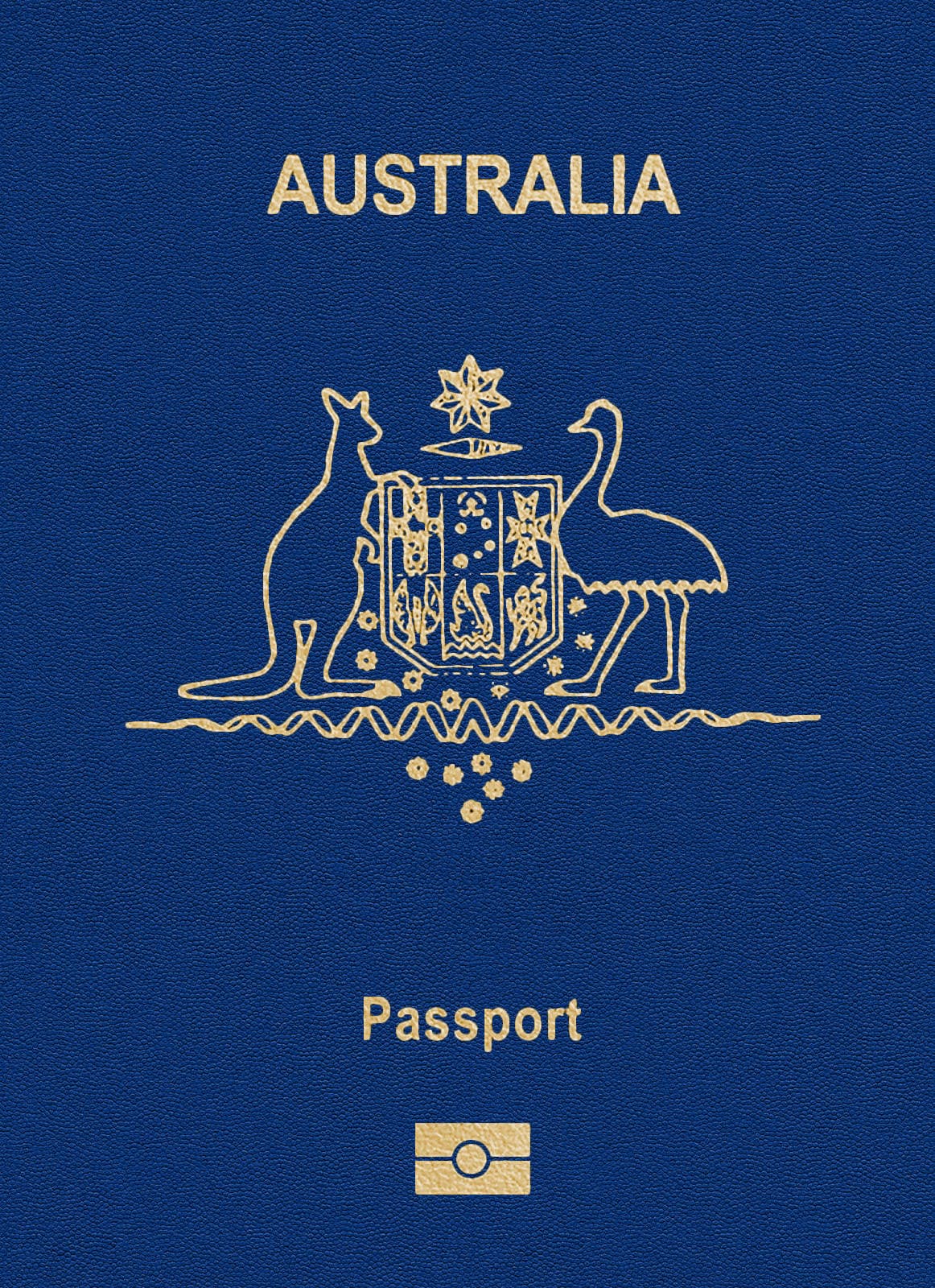
The standard Australian passport has a navy blue cover featuring the Commonwealth Coat of Arms embossed in gold. The words "AUSTRALIA" and "PASSPORT" are printed in gold, with the kangaroo and emu of the Australian coat of arms framing the Federation Star. The biometric chip symbol is displayed near the bottom of the cover, indicating compliance with ICAO standards. Inside, Australian passports feature a polycarbonate data page (introduced with the R Series in 2014), advanced security elements, and artistic imagery reflecting Australian landmarks, biodiversity, and cultural heritage including scenes of native wildlife, the Sydney Opera House, Uluru, the Great Barrier Reef, and references to Indigenous Australian art.
Inside the Passport
The identity page includes the following details:
Passport holder's photograph
Full legal name (Surname and Given names)
Passport number
Country Code (AUS)
Nationality (AUSTRALIAN)
Date and place of birth
Sex
Date of issue and expiration
Issuing authority (Australia)
Signature of the bearer
Machine Readable Zone (MRZ)
All Australian passports issued since October 2005 contain an embedded biometric chip storing the holder's photograph, biographical data, and digital signature. Australia was a global pioneer in ePassport rollout, ahead of most other developed nations.
Visa Free Access with an Australian Passport
As of 2026, Australian passport holders can access 169 destinations without applying for a visa in advance. This includes 117 fully visa free entries and 52 visa on arrival destinations. Australians enjoy visa free access to all Schengen Area countries, the United Kingdom, the United States (via ESTA), Canada (via eTA), Japan, South Korea, Singapore, Malaysia, Hong Kong, Taiwan, and most of Latin America. Visa on arrival is available in destinations like the Maldives, Nepal, Cambodia, Jordan, Madagascar, and many Pacific island nations. Only 29 of the world's countries require Australians to apply for an advance visa, including Russia, India, China (with conditional visa free transit options), Pakistan, and Saudi Arabia.
Australian citizens enjoy two unique travel advantages that few other passports offer. First, the Trans Tasman Travel Arrangement allows Australians to enter, live, work, study, and reside in New Zealand indefinitely with no visa requirement. Second, the APEC Business Travel Card (ABTC) provides Australian business travellers with streamlined entry to APEC member economies including Brunei, Chile, Hong Kong, Indonesia, Japan, Malaysia, Mexico, Papua New Guinea, Peru, Philippines, Russia, Singapore, South Korea, Taiwan, Thailand, and Vietnam. Additionally, Australia has bilateral pre Schengen visa waiver agreements with several European countries that allow stays beyond the standard 90 day Schengen limit.
Passport Strength and Ranking
According to the Atlys Passport Index 2026, the Australian passport ranks 8th globally with a mobility score of 169. Australia has held a steady top 10 position for over a decade, helped by its G20 status, Commonwealth ties, and reciprocal visa free agreements with most major economies. The Australian passport ranks closely with Canada (also 8th) and the United States (9th), but trails the top tier of EU passports (Germany, France, Italy, Spain at 2nd or 3rd, score 174-175) and the UAE (1st, score 182). Australia's slight gap to top EU passports reflects the EU's freedom of movement advantage rather than any weakness in Australia's bilateral network.
The Australian passport is one of the most valuable travel documents in the world, reflecting Australia's diplomatic reach, economic stability, and strong international standing. With access to 169 visa free or visa on arrival destinations, biometric security since 2005, the unique Trans Tasman Travel Arrangement with New Zealand offering unlimited residency rights, APEC Business Travel Card benefits, and a network of pre Schengen bilateral agreements, the Australian passport continues to offer some of the broadest travel freedom available globally.